You might think Montreal’s six world-class treatment plants, like Atwater and Des Baillets, guarantee perfect hydration by the time it reaches your desk. The reality is that while the city produces safe water, the journey through aging infrastructure often compromises the tap water quality Montreal office teams actually experience. With a 26% water loss rate due to system leaks and the March 2026 mandate for lead pipe replacements, the “final mile” of plumbing in downtown or Old Montreal often introduces unwanted contaminants, chlorine odours, and metallic tastes.
It’s a hassle to deal with the sharp scent of chemicals or the logistical clutter of 5-gallon jugs. You deserve better than heavy lifting and the constant mess of plastic waste. Discover how Montreal’s water treatment process works and why localized, point-of-use filtration is the essential final step for professional-grade hydration. We will explore the latest 2026 municipal water standards and show you how to upgrade to a system that offers unlimited, sparkling, or still water with no bottles, no lifting, and no hassle.
Key Takeaways
- Discover the 6-step purification journey Montreal water takes from the Saint Lawrence River to your building’s main intake.
- Learn why aging infrastructure and the 2026 lead pipe replacement mandates mean tap water quality Montreal office teams receive often requires localized filtration.
- Identify the logistical burdens and physical hazards of 5-gallon jugs and how to reclaim your office space for good.
- Compare the performance and cost-efficiency of professional-grade bottleless dispensers versus basic residential filters.
- Explore how to upgrade your workplace with a “no bottles, no lifting, no hassle” system that includes premium on-tap sparkling water.
What are Water Treatment Plants and How Do They Serve Montreal?
Montreal relies on a massive network of infrastructure to keep the city running. At the heart of this system are water treatment plants. These industrial facilities pull raw water from the Saint Lawrence River and transform it into a product that meets strict Health Canada guidelines. Their primary mission is simple: strip away pathogens, bacteria, and sediment so the water is safe for human consumption. While the city manages six different plants, they all share the same goal of protecting public health through a rigorous water treatment process.
Don’t confuse these facilities with wastewater centres. In Quebec, the two serve opposite functions. Wastewater plants, such as the Jean-R.-Marcotte facility, handle the effluent you flush away to ensure it doesn’t pollute the river. Drinking water plants focus entirely on what you consume. However, even the most advanced municipal plant has its limits. Once the water leaves the facility, it enters a “grey zone” of aging municipal mains and private plumbing. This is why Point-of-Use (POU) filtration has become the necessary final stage of the journey. It’s the only way to guarantee the water in your glass is as clean as the water leaving the plant.
Montreal’s Primary Facilities: Atwater and Des Baillets
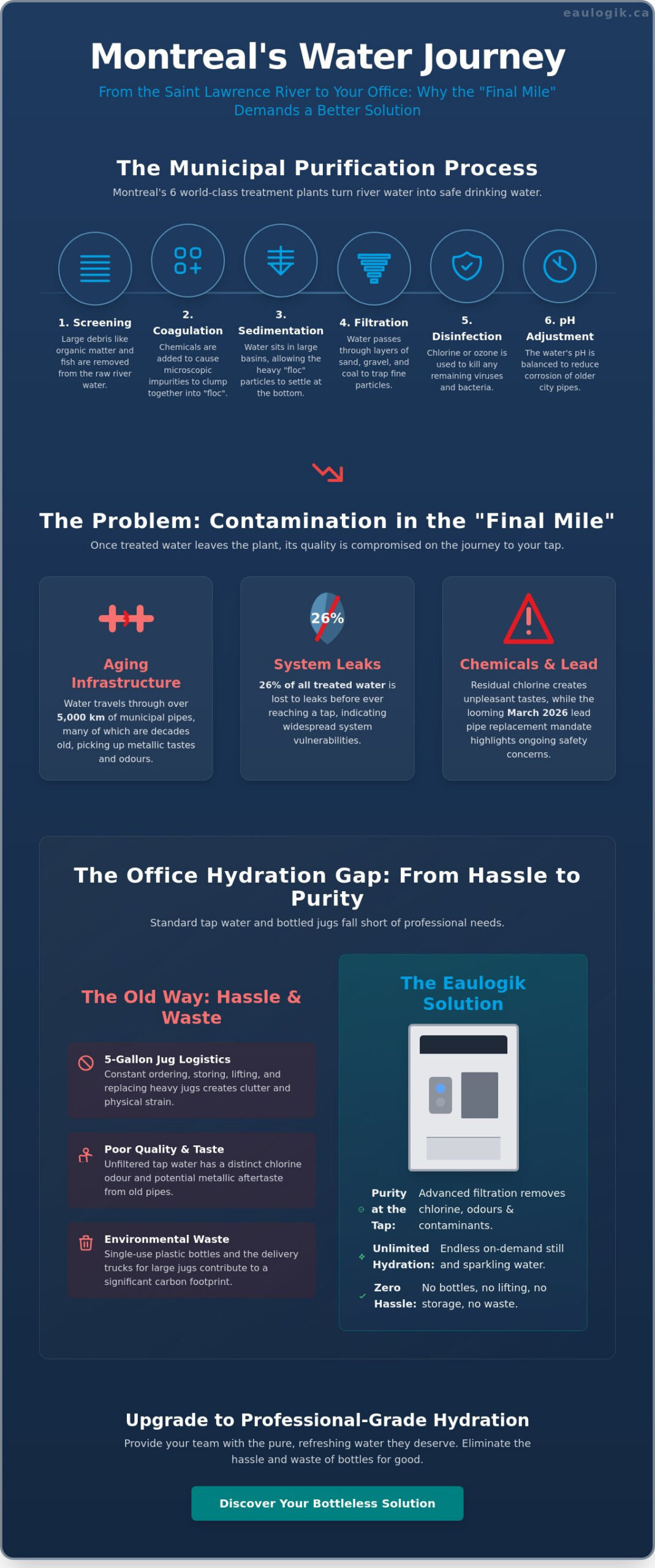
The Atwater plant, established in 1918, and the Charles-J.-Des Baillets plant, opened in 1978, are the workhorses of the island. Together, they provide the vast majority of the drinking water for the Island of Montreal and the West Island. These plants have a massive capacity, pumping out hundreds of millions of litres every day. The problem isn’t the production; it’s the delivery. Montreal’s water must travel through over 5,000 kilometres of piping. Much of this network is aging, and a 2020 report confirmed that 26% of treated water is lost to leaks before it ever reaches a tap. As water sits in these old pipes, it can pick up debris or metallic tastes that compromise the experience at your desk.
The Standard for Safe vs. Premium Water
The Quebec regulatory framework for 2026 sets a high bar for potability. It includes strict limits on lead (5 ppb) and newly enforced standards for manganese. While this ensures the water is “safe,” safety does not equal quality. To keep the water sterile during its long trip through the city, plants add residual chlorine. This chemical is vital for preventing bacterial growth, but it creates a distinct, unpleasant odour and flavour. When you evaluate the tap water quality Montreal office teams deal with daily, you’re often tasting that leftover chlorine and pipe scale. Professional hydration requires moving beyond municipal “safety” to reach a premium standard. You need a solution that removes the chemical aftertaste and delivers crisp, refreshing water on demand.
The 6-Step Process: How Modern Plants Purify Your Water
Montreal’s water treatment plants operate 24/7 to turn the Saint Lawrence River into something you can safely drink. It’s a massive industrial undertaking. The process begins with Screening, where large debris, organic matter, and even fish are removed from the intake. Next comes Coagulation and Flocculation. Plant operators add specific chemicals that cause microscopic impurities to clump together into larger particles called “floc.” This makes them heavy enough to be removed in the next stage.
Once the floc is formed, the water enters Sedimentation basins. Here, the water slows down for several hours. Gravity pulls the heavy clumps to the bottom of massive tanks. The final physical barrier is Filtration. Water passes through layers of sand, gravel, and anthracite coal. These layers are designed to trap any remaining fine particles that escaped the settling tanks. While this process is highly effective at the plant, the health risks in drinking water are constantly monitored by the city to ensure no pathogens slip through.
Disinfection and Final pH Adjustment
Before leaving the plant, water undergoes Disinfection. Montreal primarily uses chlorine or ozone to kill any lingering viruses or bacteria. Operators also perform a final pH adjustment. This is critical for Montreal’s older districts, as balanced water is less likely to corrode lead or copper pipes. However, there’s a trade-off. The city must maintain a “chlorine residual” to keep the water sterile as it travels kilometres to your building. This is why the tap water quality Montreal office staff often complain about usually features a chemical, bleach-like aftertaste. It’s a safety necessity that creates a flavour drawback.
The Limitations of Large-Scale Municipal Treatment
Municipal plants are designed for mass safety, not premium taste or variety. They can’t provide on-demand sparkling water or remove the specific sediment from your building’s 50-year-old risers. Even with perfect plant output, the final quality depends on the “last mile” of plumbing. Secondary contamination from lead service lines, which property owners are now legally mandated to replace as of March 2026, remains a localized risk. To bridge this gap, many businesses choose to upgrade their office hydration with a final filtration layer. It’s the only way to ensure your team has access to unlimited, high-quality water without the logistical nightmare of heavy jugs. Ditch the clunky dispensers and provide a solution that works for everyone.
Municipal Safety vs. Office Quality: Why Localized Treatment Matters
The City of Montreal does its job well at the source. According to official information from the City of Montreal, the water leaving the Atwater and Des Baillets plants is some of the safest in the world. However, municipal safety is just the baseline. For a business in the Greater Montreal Area, the water traveling through kilometres of cast iron mains often arrives with a metallic tang or a heavy chemical scent. Localized treatment bridges the gap between municipal compliance and the premium tap water quality Montreal office teams expect for their daily hydration.
Relying on the municipal plant alone means you’re at the mercy of your building’s internal plumbing. In older districts like the Plateau or downtown, sediment and pipe scale can easily infiltrate your lines. Ditch the expensive 5-gallon jugs that clutter your storage room. They’re a logistical nightmare and a physical hazard for your staff. A point-of-use system is far more cost-efficient because it treats the water you already pay for. While Montreal’s 2026 commercial water rates are based on volume, the cost per litre of bottled water remains exponentially higher. It’s time to stop paying for plastic and start investing in performance. Learn how Montreal businesses are taking this further by working to reduce plastic water bottle waste in their offices while modernizing their hydration infrastructure to meet Quebec’s evolving environmental standards.
The Chlorine Problem in Montreal Offices
Employees often avoid the tap because of the sharp, bleach-like odour. It’s a common complaint in Montreal workplaces. This scent comes from the residual chlorine required to keep the city’s vast network sterile. While it’s necessary for safety, it ruins the flavour of your morning coffee and discourages staff from staying hydrated. Carbon-block filtration at the point of use effectively removes 99% of these taste and odour issues. In a professional setting, there’s a massive difference between “filtered” water from a pitcher and “purified” water from a high-grade dispenser. One merely catches large particles; the other strips away the chemical residuals that compromise your team’s experience.
Sustainability: Beyond the Treatment Plant
Sustainability is a core pillar of corporate social responsibility (CSR) for Montreal businesses in 2026. Transporting heavy 5-gallon jugs across the city creates a massive carbon footprint. It’s inefficient and outdated. Every delivery truck adds to the city’s traffic and emissions. The environmental impact of 5-gallon water jugs on Montreal offices extends far beyond plastic waste, encompassing transport emissions, microplastic leaching, and the hidden costs that stall progress toward the city’s 2030 zero-waste goals. By switching to a bottleless system, you align your office with modern environmental goals. You eliminate the plastic waste and the energy required for constant manufacturing and transport. It’s a cleaner, smarter way to operate. Provide your team with unlimited, crisp water with no bottles, no lifting, and no hassle.
Case Study: Transitioning a Montreal Office to Localized Treatment
Consider the scenario of a 50-person creative agency located in a historic building in Old Montreal. For years, they managed their hydration the “old way.” This meant juggling 5-gallon jugs that ate up precious square footage in their kitchenette. Every winter, the logistical nightmare intensified as delivery trucks struggled through snow-clogged narrow streets. Staff members were tired of the heavy lifting, and the office manager was frustrated by inconsistent supply. Worse, the water often had a distinct metallic aftertaste due to the building’s century-old internal plumbing.
They decided to ditch the clutter and upgrade. By implementing a bottleless office water dispenser, they transitioned to a streamlined, direct-line system. The change was immediate. They reclaimed their storage closet and eliminated the physical risk of injury from lifting heavy bottles. After a 12-month period, the ROI was undeniable. They stopped paying for plastic, delivery fees, and fuel surcharges. Employee morale spiked because they finally had access to unlimited, crisp water that tasted professional rather than chemical.
Step 1: The Water Quality Audit
We began the transition with a comprehensive water quality audit. In Old Montreal, where infrastructure dates back decades, verifying the tap water quality Montreal office teams actually receive is vital. We tested for sediment, residual chlorine, and lead levels to ensure compliance with the latest 2026 provincial standards. Based on their 50-person headcount and frequent client meetings, we calculated their daily litre requirements. We also evaluated the existing plumbing to ensure a seamless, discreet connection to the main water line without damaging the historic character of the office.
Step 2: Customizing the Filtration Profile
One size never fits all in a professional environment. We tailored the filtration profile to solve the agency’s specific taste and odour issues. High-grade carbon blocks were used to strip away the heavy chlorine scent common in downtown Montreal. To elevate the employee experience, we integrated sparkling water options directly into the tap. This allowed the agency to stop purchasing expensive canned sodas and sparkling bottles for guests. The final setup was sleek, efficient, and perfectly matched the aesthetic of their modern workspace. It provided a premium hydration experience with no bottles, no lifting, and no hassle.
Stop settling for clunky, outdated water solutions that drain your budget and your energy. If your team is ready for a better way to hydrate, contact us to start your office water upgrade today.
Choosing the Right Solution for Your Montreal Property
Stop settling for residential-grade pitchers or basic faucet filters. In a professional environment, these retail solutions fail to handle the high volume and specific contaminants found in the city’s aging infrastructure. A professional system is designed for endurance. It provides consistent flow rates and high-capacity filtration that a consumer-grade filter simply cannot match. When you evaluate the tap water quality Montreal office teams deal with daily, it’s clear that a robust, point-of-use (POU) system is the only way to ensure every glass is crisp and odour-free.
It’s time to ditch the jug for good. The era of storing clunky plastic bottles and managing messy delivery schedules is over. Modernizing your office means integrating a system that works as hard as your team does. For facility managers looking to upgrade their water infrastructure in 2026, use this essential checklist:
- Daily Capacity: Does the system support your peak headcount and guest traffic?
- Filtration Grade: Does it use medical-grade UV or high-performance carbon blocks to strip chlorine and sediment?
- Feature Set: Do you require on-demand sparkling water to replace expensive canned alternatives?
- Plumbing Compatibility: Can the unit connect directly to your building’s main line for a “no bottles” experience?
- Service Proximity: Is the provider based in Montreal for rapid response times?
The Eaulogik Advantage: Local Service and Support
Experience matters. We’ve spent over 30 years serving the Greater Montreal Area, from the skyscrapers downtown to the industrial hubs in Saint-Laurent. We aren’t a national conglomerate based in another province. We’re your neighbours. This local focus means we understand the specific challenges of Montreal’s water grid better than anyone else. Our maintenance schedule is assertive and no-nonsense. We handle the filter changes and system checks so you don’t have to. If a problem arises, our technicians are minutes away, not days. You get a reliable partner who values your time and your team’s well-being.
Next Steps for Your Facility
The transition to better water is seamless. It starts with a professional site assessment. We visit your property to test your current tap water quality Montreal office levels and identify the best connection points for a direct-line system. Our installation process is clean, fast, and professional. We work around your schedule to ensure zero downtime for your staff. By the time we leave, your office will be equipped with a premium hydration station that delivers unlimited, sparkling, or still water. Modernize your workspace by finishing what the municipal treatment plant started. Choose the solution that offers no bottles, no lifting, and no hassle. Book your Montreal site assessment today and experience the difference of professional hydration.
Elevate Your Workplace Hydration Today
Montreal’s water treatment plants provide a solid foundation, but they can’t control what happens in the final mile of aging infrastructure. As we’ve explored, residual chlorine and building-specific sediment frequently degrade the tap water quality Montreal office teams experience every day. While the city ensures safety at the source, premium taste and operational efficiency are responsibilities that fall to individual facility managers.
Stop settling for the logistical mess of winter deliveries and the physical strain of 5-gallon jugs. With over 30 years of local expertise, Eaulogik delivers advanced UV and carbon filtration technology tailored specifically for Quebec’s unique water profile. It’s the most effective way to remove chemical odours and metallic aftertastes while providing a high-end experience for your staff and guests.
Modernize your workspace with a streamlined system that guarantees no bottles, no lifting, and no hassle. Ditch the jugs and upgrade your office water with Eaulogik. You deserve a hydration solution that is as professional and efficient as the rest of your business.
Frequently Asked Questions
Are Montreal water treatment plants safe?
Yes, Montreal’s water treatment plants are highly safe and strictly regulated by provincial standards. The city conducts extensive testing across its network to ensure compliance with health guidelines. While the water is safe when it leaves the facility, the journey through aging infrastructure can introduce sediment or lead. This is why many businesses focus on the tap water quality Montreal office staff actually receive at their desks.
What is the difference between a water treatment plant and a wastewater plant?
Water treatment plants produce potable water for your taps, while wastewater plants treat what goes down the drain. Drinking water facilities pull from the Saint Lawrence River to serve the city’s consumption needs. Wastewater centres process effluent to prevent environmental pollution before returning it to the river. They are two entirely separate systems with different purification goals.
Why does my office water taste like chlorine if it comes from a treatment plant?
Your water tastes like chlorine because plants must maintain a residual level of the chemical to prevent bacterial growth during distribution. It’s a safety requirement for the thousands of kilometres of piping between the plant and your building. While effective for health, it creates a bleach-like odour and a sharp aftertaste. Point-of-use filtration removes this chemical right before it hits your glass, restoring the natural flavour.
How much do localized water treatment systems cost in Canada?
Costs for localized systems in Canada vary based on your headcount and specific filtration requirements. Most professional providers offer fixed monthly rental agreements that include all maintenance and filter changes. This model is more cost-efficient than the fluctuating expenses of 5-gallon jug deliveries. It allows for predictable budgeting without the hidden fees or price hikes associated with bottled water transport.
Do I need a plumber to install a bottleless water dispenser?
You don’t need to hire an outside plumber for a bottleless water dispenser installation. Professional providers handle the entire setup process using a discreet, food-grade line connected directly to your existing water source. The installation is quick and clean. It won’t disrupt your office operations or require major renovations to your kitchenette or breakroom area.
How often do filters need to be changed in a professional office water system?
Professional office water systems typically require filter changes every six to twelve months. This frequency depends on your staff size and the actual volume of water consumed. A proactive maintenance schedule ensures the filtration technology remains effective against sediment and chlorine residuals. We manage these updates automatically so you never have to worry about degrading water quality or system downtime.
Can a bottleless system provide sparkling water on tap?
Yes, modern bottleless systems can provide unlimited sparkling water on demand. These professional units replace messy countertop carbonators and the constant waste of canned fizzy drinks. You get crisp, chilled sparkling water at the touch of a button. It’s a premium upgrade that boosts employee morale and provides a sophisticated hydration option for your clients and guests.
Is tap water in Montreal actually better than bottled water?
Montreal tap water is often safer and more frequently tested than many bottled alternatives. Municipal water is tested daily, whereas bottled water companies are subject to less frequent reporting under federal guidelines. When you add a final layer of professional filtration, tap water becomes the superior choice. It eliminates plastic waste, reduces your carbon footprint, and provides better hydration with no bottles, no lifting, and no hassle.