What if your office espresso machine lasted twice as long and your morning coffee didn’t smell like a public swimming pool? In the Greater Montreal Area, business owners often find themselves scrubbing white scale off C$2,500 appliances or lugging heavy salt bags just to get a decent glass of water. It’s a frustrating cycle of maintenance and physical labour that wastes both time and money. You shouldn’t have to choose between chalky buildup and the constant hassle of traditional softening systems. Our team has spent 30 years helping locals move past these outdated water problems.
We agree that your water should be an asset, not a chore. This guide will show you how to choose and maintain the ideal water conditioner to eliminate scale and neutralize chlorine taste for good. You’ll discover how to get crystal clear water on demand while reducing your kitchen appliance maintenance costs significantly. We’ll preview the latest sustainable technologies that provide a “no bottles, no lifting, no hassle” experience for your home or workspace, ensuring you never have to settle for subpar tap water again.
Key Takeaways
- Stop settling for the “slimy” feel of softened water and discover why a salt-free water conditioner is the superior choice for a crisp, refreshing taste.
- Identify the hidden warning signs in your building’s plumbing that compromise water quality, regardless of the city’s official reports.
- Learn how to accurately calculate your peak water demand and select the perfect filtration grade to organize a system that scales with your team.
- Ditch the heavy lifting and logistical clutter with integrated dispensers that offer high-performance scale prevention and professional-grade carbonation.
Understanding Water Conditioning in the Montreal Context
Montreal tap water has a reputation for being “soft,” but that’s a dangerous misconception for local business owners and homeowners. While our water doesn’t reach the extreme hardness levels found in the Prairies, it’s far from pure. A professional water conditioner offers a salt-free solution to manage the specific mineral profile of the St. Lawrence River without the slimy feel of traditional softeners. Ditch the idea that “clear” water is “clean” water. If you’re seeing white spots on your glassware or office kettle, your water is working against you.
Many people confuse basic carbon filtration with true conditioning. Carbon filters are great for removing taste and odour, but they don’t stop scale from destroying your expensive office coffee equipment. Conditioning changes how minerals behave on a structural level. It’s a proactive approach that saves your plumbing while keeping your water tasting crisp and natural. It’s about efficiency, not just flavour. It’s time to upgrade to a system that handles Montreal’s unique seasonal shifts. Before making any decisions, it’s worth exploring water conditioning in Montreal and the common myths that prevent offices from making the switch.
The Montreal Water Profile: Hardness vs. Chemicals
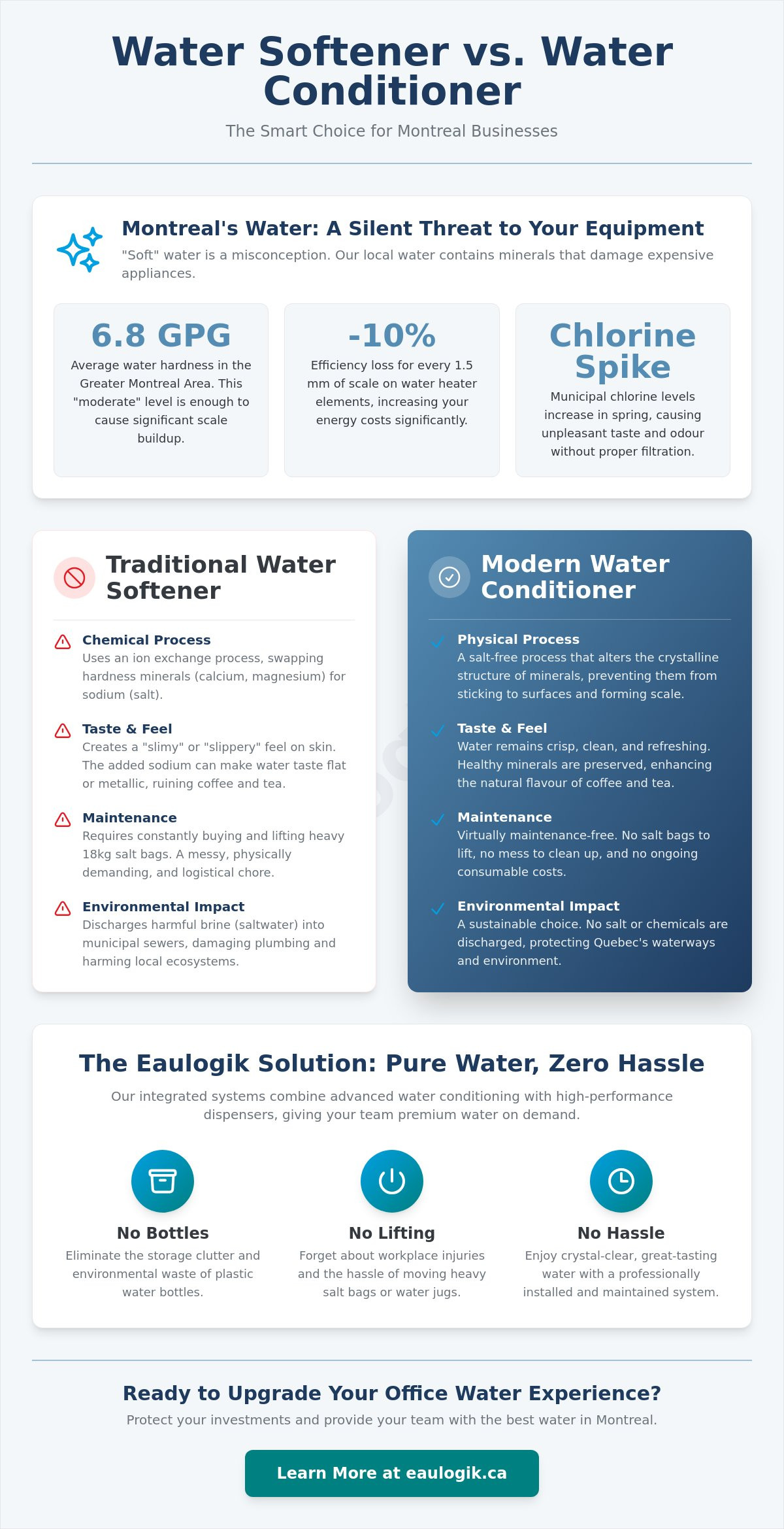
The Greater Montreal Area averages roughly 6.8 grains per gallon (GPG) of hardness according to recent municipal reports. This “moderate” level is a silent killer for high-end brewers and boilers. By the time you see white crust on a tap, the internal heating elements are already failing. Consider these facts about our local supply:
- Scale buildup can reduce water heater efficiency by 10% for every 1.5 mm of mineral accumulation.
- During spring run-off in March and April, the city increases chlorine dosages to neutralize organic matter from melting snow.
- The St. Lawrence River source contains varying levels of dissolved solids that fluctuate with the seasons.
This spike in chlorine makes tap water smell like a public pool. A robust system manages these seasonal shifts, ensuring your team isn’t drinking “springtime” chemicals with their morning brew. You need a solution that’s as consistent as your business.
Conditioning vs. Softening: The Core Difference
A water conditioner is a physical process rather than a chemical exchange. Unlike water softening, which swaps calcium for sodium, conditioning alters the crystalline structure of minerals so they can’t stick to surfaces. This preserves healthy minerals like magnesium while preventing the “crusty” buildup that clogs pipes and ruins machinery. It’s the smarter, modern way to treat water without adding unnecessary salt to your diet or your drains.
Quebec’s environmental standards are tightening, and for good reason. Salt-based softeners discharge heavy brine into our waterways, which harms local ecosystems and violates the spirit of sustainable business. Choosing a salt-free water conditioner is the responsible choice for Montreal offices. You get better water, zero salt bags to lift, and a smaller environmental footprint. It’s a professional upgrade that delivers results without the mess. No bottles, no lifting, no hassle.
Water Softener vs. Water Conditioner: Which is Best for Your Office?
Montreal business owners often confuse softening with conditioning. They aren’t the same. Softeners use salt to swap minerals for sodium. This leaves water feeling “slimy” on the skin and tasting flat in a cup. A high-quality water conditioner treats the water without chemicals. It protects your equipment investment. If you’ve spent C$5,000 on a commercial espresso machine, you must prevent scale. Calcium deposits can kill a boiler in under 24 months. Conditioned water keeps the minerals but changes their form. The result is a crisp, natural taste that highlights the flavour of your coffee beans rather than masking them with salt.
The Downside of Traditional Salt-Based Softeners
Salt-based systems are a logistical nightmare in downtown Montreal. Carrying 18kg bags of salt up a narrow Plateau staircase or through a busy office lobby is a waste of energy. It’s messy. It’s heavy. Many commercial leases in the city now restrict salt-based systems because the brine discharge can damage older municipal plumbing. Beyond the heavy lifting, sodium-exchange affects the palate. It alters the delicate balance defined in the Guidelines for Canadian Drinking Water Quality, often making tea and coffee taste metallic. You end up with water that’s technically “soft” but practically unpleasant for your team to drink.
The Salt-Free Advantage for Drinking Water
Modern offices choose Template Assisted Crystallization (TAC). This technology keeps minerals in suspension so they can’t stick to pipes or heating elements. It’s the ultimate “No bottles, no lifting, no hassle” approach to water quality. You get the protection of a softener without the wastewater or the heavy salt bags. By 2026, eco-friendly office standards will likely make these systems the default choice for sustainable businesses. You save space in your compact kitchen and reduce your environmental footprint. Maintenance is a simple filter swap once or twice a year. No more storing bulky bags in your limited storage closet. It’s time to upgrade your office hydration with a water conditioner built for the modern Montreal workplace. This shift ensures your team enjoys premium water while you protect your bottom line from expensive plumbing repairs.
How to Evaluate Your Building’s Water Quality (A Montrealer’s Guide)
Montreal’s water quality starts at the treatment plant but ends in your pipes. You can’t rely on city-wide reports to judge what’s coming out of your office tap. Buildings in Old Montreal or Lachine often use infrastructure installed over 100 years ago. These older pipes introduce different contaminants than the newer systems found in Laval. You need to know what your staff is actually drinking. Start with a simple test kit for a baseline. Invest in a professional audit if you manage a high-traffic workplace or a large commercial space.
Spotting Scale and Biofilm Buildup
Check the centre of your kettle or coffee maker first. If you see white, chalky flakes, you have a hard water problem. This scale buildup destroys expensive espresso machines and clogs internal heating elements. In Westmount or the Plateau, a sharp metallic tang often signals aging copper or iron pipes. Look at your ice cubes next. Cloudy ice is a primary indicator that you need a water conditioner to strip away dissolved solids. Clear ice isn’t just for aesthetics; it’s a sign of purity. If your ice looks like a fog bank, your water is carrying a heavy mineral load.
The Chlorine and Lead Factor in Quebec
Montreal is currently working to replace approximately 48,000 lead service lines by the year 2030. Even if the city replaces its portion, your building’s internal plumbing might still pose a risk. Seasonal changes in the St. Lawrence River also affect every glass you pour. During warmer months, the city typically increases chlorine levels to combat bacteria. This results in that distinct “swimming pool” smell in the breakroom. Using drinking water treatment devices ensures your team isn’t consuming these chemicals. A high-quality water conditioner paired with sub-micron filtration removes 99.9% of these particulates. Ditch the guesswork. Upgrade to a system that handles Montreal’s specific seasonal spikes. It’s a simple way to get better water without the logistical clutter of plastic jugs. No bottles, no lifting, no hassle.
Professional water audits provide a level of detail that home kits miss. They measure exact mineral concentrations and identify specific bacterial risks. For businesses, this data is the foundation of a healthy workplace. It allows you to choose a system that targets your building’s unique weaknesses rather than a one-size-fits-all filter. Stop settling for “good enough” tap water and start demanding clarity. Understanding the myths surrounding water conditioning for Montreal offices can help you make a more informed decision when selecting the right system for your building.
Step-by-Step: How to Choose and Organize Your Conditioning System
Stop settling for mediocre tap water. Choosing the right water conditioner requires a tactical approach. You need to ditch the “one size fits all” mentality. Start by determining your peak demand. A Montreal office with 25 employees requires a different flow rate than a residential home in Plateau-Mont-Royal. If you underestimate this, you will face performance drops when everyone hits the breakroom at once. No bottles, no lifting, no hassle starts with proper planning.
Select your filtration grade based on your specific goals. Carbon filters excel at removing the chlorine taste common in municipal water. UV systems provide a chemical-free way to neutralize bacteria. For the highest purity, Reverse Osmosis is the gold standard. You also need to decide between a whole-home system or a Point-of-Use (POU) dispenser. POU systems are the modern choice for busy offices. They provide unlimited water without the logistical clutter of heavy jugs. Always verify that the conditioning media carries NSF/ANSI certification. This guarantees the system meets rigorous safety and performance standards.
Calculating Capacity and Flow Rate
An undersized water conditioner is a liability. When demand exceeds capacity, “breakthrough” scale occurs. This happens when hard water minerals bypass the system and enter your equipment. In a high-traffic office, this usually happens during the 9:00 AM coffee rush. You must match your system to the number of active dispensers. Montreal startups should prioritize modular systems. These allow you to add capacity as your team grows without replacing your entire infrastructure.
Maintenance: Keeping Your Water Pure
Pure water requires discipline. Follow the 6-month rule for filter changes in any high-traffic Montreal workspace. Waiting longer allows sediment to build up and reduces flow rates. While DIY might seem tempting, professional servicing is the better investment. Expert technicians catch small leaks before they cause expensive property damage. They also ensure your system remains compliant with Régie du bâtiment du Québec plumbing codes. For a deeper look at upkeep, read about The Secret to Longevity: Servicing Your Office Dispenser.
Ready to upgrade your office hydration with a professional setup? Explore our bottleless water solutions to find the perfect fit for your Montreal team.
The Eaulogik Solution: Integrated Conditioning and Dispensing
Montreal tap water requires more than just a basic filter. It needs a comprehensive approach. Eaulogik bottleless dispensers function as a high-performance water conditioner, neutralizing the minerals that cause scale buildup while removing the chemical taste of chlorine. This integrated system protects your internal components and ensures every drop is crisp. You can finally stop managing the logistical nightmare of 5-gallon jugs. No bottles, no lifting, no hassle. It’s a streamlined solution for a modern workspace.
The Eaulogik Edge comes from combining this scale prevention with professional-grade carbonation. Most systems fail because they don’t treat the water properly before adding CO2. Eaulogik does. By conditioning the water first, we create a stable base for bubbles that stay sharp longer. Our Montreal-based service team provides the local support you need as we head into 2026. We’ve spent three decades mastering the specific chemistry of Quebec’s water supply. We aren’t just a vendor; we’re your local water partner.
From Basic Conditioning to Premium Sparkling Water
A high-quality water conditioner is the essential first step for perfect sparkling water. Without proper conditioning, minerals and impurities interfere with the carbonation process, leading to flat, metallic-tasting drinks. Eaulogik systems solve this by purifying the water at the source. This on-tap luxury replaces expensive Perrier habits or the constant chore of exchanging SodaStream canisters. You get premium results at a fraction of the cost. Explore The Best Sparkling Water Solutions for Montreal Offices and Homes in 2026 to see how we’re changing the way the city drinks.
Sustainability and Corporate Social Responsibility (CSR)
Montreal businesses are under increasing pressure to meet strict zero-waste milestones. Switching to a conditioned bottleless system is the fastest way to boost your CSR profile. One Eaulogik unit can eliminate the need for up to 1,500 single-use plastic bottles every single year. This isn’t just a small change; it’s a measurable impact on your environmental footprint. We help you ditch the plastic and upgrade to a system that aligns with 2026 sustainability standards. It’s better for your team, your bottom line, and the planet. Upgrade your Montreal office water today and experience the Eaulogik difference.
Take Control of Your Office Hydration
Montreal water has its own unique character, and managing it shouldn’t be a chore. You’ve seen how a high-quality water conditioner provides the perfect balance by removing harsh chlorine tastes while keeping essential minerals intact. It’s the smarter, more efficient choice for any workplace that values health and sustainability. Stop dealing with the logistical clutter of heavy plastic jugs and the physical strain of constant lifting. Eaulogik brings over 30 years of local Montreal expertise to your space, a track record proven by dozens of 5-star reviews from businesses across the city. Our systems offer unlimited, professional-grade water on demand, including premium sparkling options that elevate the standard office break. We promise a seamless transition with our “no bottles, no lifting, no hassle” guarantee. You deserve a system that works as hard as you do without the extra maintenance. It’s time to enjoy better water without the old-fashioned drawbacks.
Ditch the jugs and upgrade to a conditioned bottleless system today!
Frequently Asked Questions
Is Montreal water considered hard or soft?
Montreal tap water is officially classified as moderately hard. Data from the City of Montreal shows hardness levels ranging between 90 and 120 mg/L. While it isn’t as severe as water in the Prairies, it still causes scale buildup in pipes and appliances over time. You’ll notice white spots on glassware or stiff laundry. Upgrading to a water conditioner prevents these mineral deposits from sticking to your fixtures.
What is the main difference between a water softener and a water conditioner?
A water softener removes minerals like calcium and magnesium entirely through an ion exchange process. In contrast, a water conditioner changes the chemical structure of these minerals so they cannot stick to surfaces. It doesn’t use salt or chemicals. You get the benefits of scale prevention without the slippery soft water feel. It’s a cleaner, more sustainable way to protect your plumbing from internal damage.
Do I need a water conditioner if I already have a filter?
Yes, because filters and conditioners perform different tasks. A standard carbon filter targets chemicals like chlorine and lead to improve taste. However, it won’t stop mineral scale from destroying your dishwasher or water heater. Combining a high-quality filter with a professional water conditioner ensures your water is both safe to drink and gentle on your infrastructure. It’s the ultimate upgrade for any Montreal office.
How much does a professional water conditioner cost in Montreal?
Professional conditioning systems in the Canadian market typically range from C$1,500 to C$4,000 including installation. Prices vary based on the flow rate required for your building and the specific technology used. While the initial investment is higher than a basic jug filter, it eliminates the need for expensive descaling chemicals. It also extends the lifespan of your plumbing and appliances by several years.
Can a water conditioner remove the taste of chlorine?
Most modern systems include an integrated carbon filtration stage specifically designed to neutralize chlorine. Montreal uses chlorine to disinfect its 5,000 kilometre pipe network, which often leaves a distinct chemical taste. High-quality equipment strips away these odours and flavours. You’re left with crisp, refreshing water that tastes like it came from a premium bottle, right from your tap. No bottles, no lifting, no hassle.
What happens if I don’t maintain my water conditioning system?
Neglecting your system leads to a gradual return of scale buildup and reduced water pressure. If your unit uses a sediment pre-filter, it will eventually clog and restrict flow to your faucets. Most systems require a simple check-up every 12 months to ensure peak performance. Regular maintenance prevents small issues from becoming costly repairs. Stop the hassle before it starts by scheduling a quick annual inspection.
Are salt-free water conditioners as effective as salt-based ones?
Salt-free conditioners are highly effective at preventing scale, which is the primary concern for most Montreal residents. They don’t remove minerals, so they won’t give you that slippery feeling during a shower. However, they are better for the environment and your health because they don’t add sodium to your drinking water. No salt, no heavy bags, no mess. It’s a modern solution for modern homes and businesses.
Will a water conditioner help protect my office coffee machine?
This technology is the best way to extend the life of your office coffee equipment. Mineral scale is responsible for 70% of commercial coffee machine breakdowns in hard water areas. By preventing calcium from crystallizing on heating elements, the system ensures consistent temperature and better flavour. Ditch the frequent repair calls and enjoy a reliable morning brew every single day without the logistical clutter.